Scientific American™ covers new autism therapy provided by Mendability
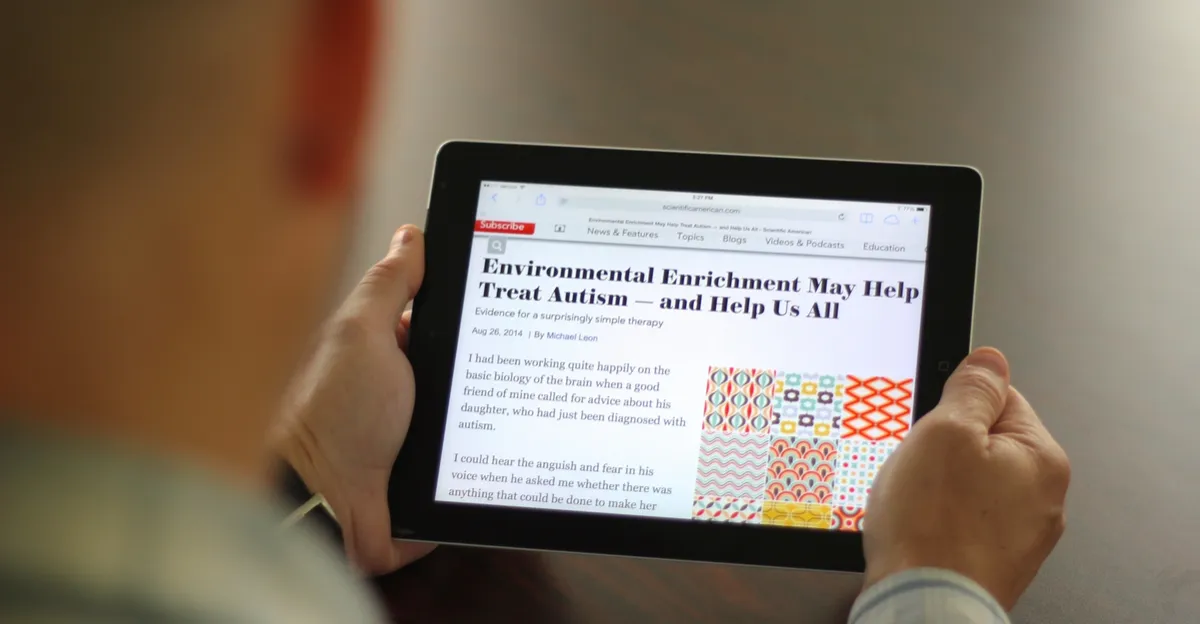
In 2014, Scientific American published a feature on an emerging approach to autism therapy that was just beginning to get serious attention: sensory enrichment.
Written by Dr. Michael Leon, the article titled “Environmental Enrichment May Help Treat Autism—and Help Us All” reported on a groundbreaking clinical trial that showed that children with autism who received sensory enrichment made significantly more progress than those who did not. In fact, twice as many children in the enrichment group improved enough to move out of the “autism” category.
This kind of national coverage is rare for alternative therapies, and for good reason—it takes rigorous science to earn that spotlight.
Dr. Leon’s study was the first randomized controlled trial showing that simple, daily sensory experiences—like smelling different scents, touching various textures, or walking on uneven surfaces—could lead to real changes in how the brain functions.
“We know that enriched environments improve brain function,” Leon explained. “The exciting part is that it can work for autism, too.”
How sensory enrichment therapy works
Sensory Enrichment Therapy is built on a well-established neuroscience principle: when the brain receives rich, varied sensory input, it creates new connections. This process—called brain plasticity—helps the brain become more organized, efficient, and resilient.
For individuals with autism, certain brain pathways may be underdeveloped or poorly connected. Sensory enrichment gently stimulates these pathways by combining multisensory experiences in short, engaging activities done daily. For example, a child might smell vanilla while running their fingers through warm beads—engaging smell, touch, temperature, and motion all at once. These types of combinations create novelty and challenge that promote brain growth.
Over time, this can help children become more comfortable in their own bodies, less overwhelmed by sensory input, and more capable of learning, communicating, and relating to others.
Why this matters
To have a major publication like Scientific American recognize this approach means families and professionals can take it more seriously. It’s not just feel-good therapy. It’s neuroscience in action—with data to back it up.
At Mendability, we’ve taken this research to heart. Our program is based on the same principles Dr. Leon described—structured, gentle sensory experiences that activate the brain’s self-healing mechanisms.
We believe in the power of parents and caregivers to deliver these experiences at home, turning everyday moments into brain-building opportunities. And we’re proud to see the science catching up to what we’ve seen in practice: that children can change—and often much more than anyone expected.