Why Sensory Enrichment Therapy for Autism Exists | Mendability
The story of how Mendability was born — and why it changes everything for your child.
In a neurological unit at Necker Children’s Hospital in Paris, there is a kind of silence that parents never forget.
These babies cannot be held. Cannot be comforted. Their arms are tied to their bodies. They cry — except nobody hears it, because the tracheostomy makes them silent.
Claudie reached into her pocket and held a small strawberry-scented fragrance vial near the baby’s tracheostomy. The baby stopped crying. Not gradually. Immediately.
But to understand why that moment changed everything — you have to go back much further.
The Boy With the Enormous Smile
Claudie grew up in a small village in the French countryside. Her father was the village doctor. She was an independent child — she walked to school alone, walked to the baker alone, spent hours in the forest behind their house without anyone looking for her.
She was happy. And most of her happiness had a name: Simon.
Simon was her best friend. They were inseparable at recess. She remembers his smile more than anything — enormous, the kind of smile that made you feel the world was fine.
Then one day, Simon wasn’t at school.
Claudie was three and a half years old. She did what made sense to her: she walked to the police station where Simon’s father worked, knocked on the door, and asked for him.
The adults said words she didn’t fully understand. What she understood was this: Simon was not here. Simon would not be coming back.
She walked home alone.
She didn’t know it then, but Simon had been placed in an institution because of developmental challenges. No one explained it. He was simply gone.
That feeling — of someone disappearing into a system that had no way to reach them — never left her.
When Words Weren’t Enough
Decades later, Claudie lost three more people she loved.
Her brother died on the street — the result of years of chronic depression, drugs, and alcohol. They learned of his death only because they had been searching for him. There was no funeral. No place to put the body. Just information arriving like a fact.
Her sister, who had two daughters, took her own life.
Her mother did the same.
All three had struggled their entire lives with depression — a chronic inability to find their place in the world. Psychology had tried. Words had been offered. But nobody had really been reached.
Claudie had studied psychology. She knew the tools. And she knew they weren’t working — not for the people she loved, not for many of the people she watched try.
It was around this time that she began reading the early research papers from neuroscientists working in the field of environmental enrichment. What she read stopped her.
The brain is not fixed. It responds to the right experiences. Enriched environments reverse deficits, change emotional behavior, restore function. The research had been demonstrating this for decades.
Psychology worked with words. But what if the answer was deeper than words? What if it was in the brain itself?
She didn’t walk away from that reading uncertain. She walked away with a mission.
Brain Development in French Daycares
Before she ever worked with sick children, Claudie spent three years studying something she thought would be much simpler.
She was working in a large government daycare in France. She introduced sensory enrichment activities into the children’s daily environment — nothing dramatic, carefully chosen sensory experiences woven into ordinary days.
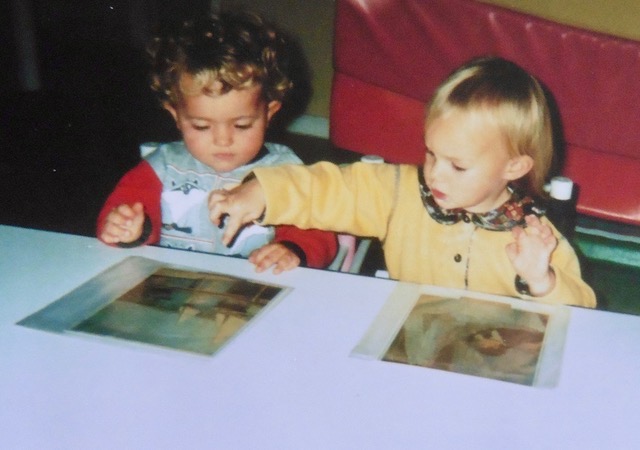
What happened over those three years was not what anyone expected.
These children were developing differently. Not just faster — differently. Some went from sitting to standing to walking, skipping crawling entirely. They developed empathy unusually early. They showed a curiosity about food, about art, about the world that was remarkable for their age.
They had been showing the children paintings since they were three months old.
One day, a little girl — no older than two — sat looking at Van Gogh’s painting of his bedroom. You may know it. Bright colors. Turquoise sky through the window. A red comforter on the bed. It looks cheerful.
She sat very still. Longer than you would expect any child to sit. Then she turned to her caregiver and said:
“It’s dark. It’s sad.”
She was not describing what she saw. She was reading what Van Gogh felt when he painted it. If you know the context — that Van Gogh painted that room repeatedly while severely depressed, and later took his own life — you understand that she was right.
Nobody taught her that. Nobody drilled it. It emerged.
Claudie gathered the videos, documented everything, and brought her findings to the leading scientific institutions in France — the CNRS and the INSERM, the French equivalent of the NIH.
They told her it was remarkable. And they told her she needed to bring this to children for whom the stakes were not developmental acceleration, but survival and quality of life.
A Paris Hospital. A Baby. A Strawberry.
The study was conducted in the neurological unit of Necker Children’s Hospital in Paris. The population was babies born with Pierre Robin syndrome.
These babies cannot suck. Cannot swallow. Cannot breathe on their own. Their cranial nerves are impaired from birth. Their arms are tied along their bodies so they cannot pull out the tubes keeping them alive. They cannot be held, carried, or comforted in any of the ways every parent is built to comfort a child.
They cried — except nobody heard it. The tracheostomy made them silent. Their parents sat beside them and watched.
No intervention existed for what these babies were experiencing neurologically. The medical system had kept them alive. But nobody had figured out how to reach them.
Claudie reached into her pocket. She happened to have a small fragrance vial — strawberry-scented. She held it near the baby’s tracheostomy.
The baby stopped crying. Not gradually. Immediately. The face changed. The body settled. No instructions. No repetition. No compliance training. Just the right sensory input reaching a brain that was desperate to feel safe — and the brain responding.
She came back with peach. With lemon. With other gentle, pleasurable scents. Each time, the same response. The brain was reachable. It had always been reachable. It just needed a different way in.
She then showed the mother how to do the full protocol — combining the scent with the image of the fruit and gentle touch along the arms and face. When she brought the scent close, the baby began to salivate. Sucking movements appeared in her lips.
The mother watched. Then she said, almost to herself:
“She likes food. She is…”
She couldn’t finish the sentence.
That was the moment Claudie understood what sensory enrichment could actually do. Not as a theory. As something she watched happen in the hardest possible circumstances, with a baby who had no other way to be reached.
From Paris to an Old RCMP Station in Alberta
After the Necker study, Claudie knew the science worked. Not suspected — knew. She had watched it happen with some of the most neurologically compromised babies in France.
She began sending proposals to hospitals and institutions in the United States and Canada, offering to train health professionals in sensory enrichment protocols. Most didn’t respond.
Canada did. They offered a visa and a one-year contract to train nurses in the NICU.
She moved to Okotoks, Alberta — a small town south of Calgary — and bought an old RCMP station that she converted into a clinic. The nurses in the NICU were not particularly receptive. She didn’t let it slow her down.
For the next several years she traveled back and forth between Canada and France twice a month, continuing the Necker study while building her practice in Alberta. She accumulated enough airmiles to fly business class permanently. She joked that the upgrade was the one reliable perk of the schedule.
She was on fire. She knew what the science said was possible, and she intended to be loud about it until the right people heard.
The Scientists Come to Calgary
In 2000, 2001, and 2002, Claudie organized the Sensory Enrichment Symposia in Calgary. She invited researchers in environmental enrichment from across the world — neuroscientists, clinicians, educators — and brought them together with doctors, health professionals, teachers, parents, and nurses.
It was an unusual idea: take the science that was producing results in animal laboratories and put it in a room with the people who were actually trying to help children. Let them meet each other.
One of the scientists who came to Calgary was Dr. Michael Leon, Associate Dean at the School of Biological Sciences at the University of California, Irvine. He had spent years studying how enriched environments accelerated brain development in rats. When he heard what Claudie was doing with children, he came to see it for himself.
He visited the clinic. He watched the sessions. He met the families. He saw children with severe neurological challenges who were calmer, more present, more connected — and he heard what their parents were witnessing at home.
He told her the program she had developed was mature enough to be tested in a proper randomized controlled trial.
The Cases Nobody Else Would Take
As word spread through the medical community in Alberta, the government began sending Claudie the cases that had exhausted every other option.
Children with pachygyria type 2. Cerebral palsy. Severe global developmental delay. Early autism. These were not straightforward cases. They were children who had been through the system and arrived at the edge of what it knew how to do.
They got better. Significantly. Consistently.
One of those children was a Spanish-speaking boy named Jesús. He had cerebral palsy and arrived in a wheelchair. He left without one.
People joked, with genuine awe, that Claudie had made Jesús walk.
It was story after story like that. A child no one could reach, reaching back. A family that had stopped hoping, starting to hope again. I was watching all of it from the inside, and I understood that I was exactly where I was supposed to be — helping people find happiness who could not find it on their own.
The Dream I Had Three Times
My name is Kim. I am Claudie’s son. I was running a profitable graphic design company at the time. I loved making things — I doodled constantly, built things with my hands, found real satisfaction in turning an idea into something real.
I started helping my mother because she needed systems, documentation, structure. I had those skills. It seemed simple enough.
But then I kept watching.
The children kept improving. Not occasionally. Consistently. And the stories the parents told — the meltdown that stopped, the first word, the morning the child slept through the night for the first time in years — started to sound less like clinical outcomes and more like the word people use when they don’t have a better one. Miracles.
I remembered a dream I had as a teenager. I had it three times, always the same.
I was looking into a house — the front wall open so I could see inside. Multi-story, laid out like an old friend’s home. Dozens of teenagers were coming through the door, to eat, to hang out, to play foosball. It was a happy place. They kept coming because they wanted to be there.
As a teenager I had assumed it meant I would build something like that someday — maybe an orphanage, when I had the resources. A place where kids felt safe and welcome.
Standing in my mother’s clinic, watching these families, I understood that this was it. Not a building. A different kind of home.
I closed the design company and started documenting everything.
Building the System
Every game. Every variation. Every protocol Claudie had developed through years of clinical work. I documented it all — not just what she did, but why it worked, what brain systems it was targeting, what patterns she had observed across different children.
Later, with a friend who was an automation engineer, I expanded the idea. We built a tool that could take a child’s specific neurological profile and generate structured, personalized activity recommendations based on patterns from all the previous cases.
Claudie ran it in parallel with her own clinical judgment. Again and again, she would say: the activities it proposes are appropriate, safe, and well targeted. Not identical to her intuition, but strong.
That was the moment we knew it could scale.
What the Science Found
Dr. Leon wanted to run a proper randomized controlled trial. There was just one problem: nobody would fund it.
Non-pharmaceutical interventions are notoriously difficult to get funded. There is no patent. No pharmaceutical company with a financial stake in the outcome. Leon had the scientific credibility and the research design. What he didn’t have was money.
I sent an email to our newsletter. I explained what the study could mean for thousands of children with autism and asked if anyone was in a position to help. I genuinely didn’t know what would come back.
One of the first responses came from the father of a young woman named Leya Aronoff.
Leya had come to Claudie’s clinic as a child — largely non-verbal, slow to process, lost in her own world. Eighteen months later she had graduated with a normal developmental profile. Years after that, she became the communications director at one of the largest consulting firms in California. She has given several TED talks.
Her father had watched every step of that journey. He didn’t need convincing. He funded the study.
The results are published in peer-reviewed journals. You can read them today.
In the first clinical study, 42% of children who did Sensory Enrichment Therapy for fifteen minutes a day at home showed significant clinical improvement after six months.
In the standard care group — the children doing ABA, occupational therapy, speech therapy, physiotherapy — 7% improved significantly.
Six times more progress. With fifteen minutes a day. At home.
In the replication study, researchers re-diagnosed every child after six months. 21% had moved up by a full autism classification. They no longer met the criteria.
And something else happened that cannot be explained away. The IQ of the children increased.
You cannot train a child to have a higher IQ with flashcards and drills. IQ doesn’t respond to repetition. But it responds to a brain that is more connected, more adaptable, more capable of integrating information across systems.
IQ is still, to this day, the strongest predictor we have of quality of life and independence in the future.
When Leya’s father saw those results, he offered to invest in building the company.
Why This Exists
Mendability was founded in 2011, with Leya’s father among the first investors — a man who had watched his daughter go from unreachable to extraordinary, and who believed that story should not be rare.
The software engine was mature. The clinical evidence was published. The former families who had seen the results firsthand were ready to help carry it forward.
Because miracles that reach only a handful of families in a clinic in Alberta are not enough.
What This Means for Your Child
The science existed long before Mendability did.
The gap was never in the research. The gap was in the translation — between what neuroscience knew and what parents could actually do, at home, without a laboratory or a clinic or a specialist in the room.
That translation is what Mendability was built to be.
Your child’s brain is not fixed. It is responsive. It is waiting for the right input — the kind that reaches it where it actually lives, below behavior, below performance, below compliance.
The babies whose arms were tied to their bodies — they could be reached with a strawberry.
Simon, who disappeared into a system that had no way to reach him — he is why this work exists.
And the parents who arrive at Mendability exhausted, skeptical, and quietly terrified that this is as good as it gets — they are who this was built for.
If you want to understand how Sensory Enrichment Therapy works and whether it is right for your child, start here → mendability.com