
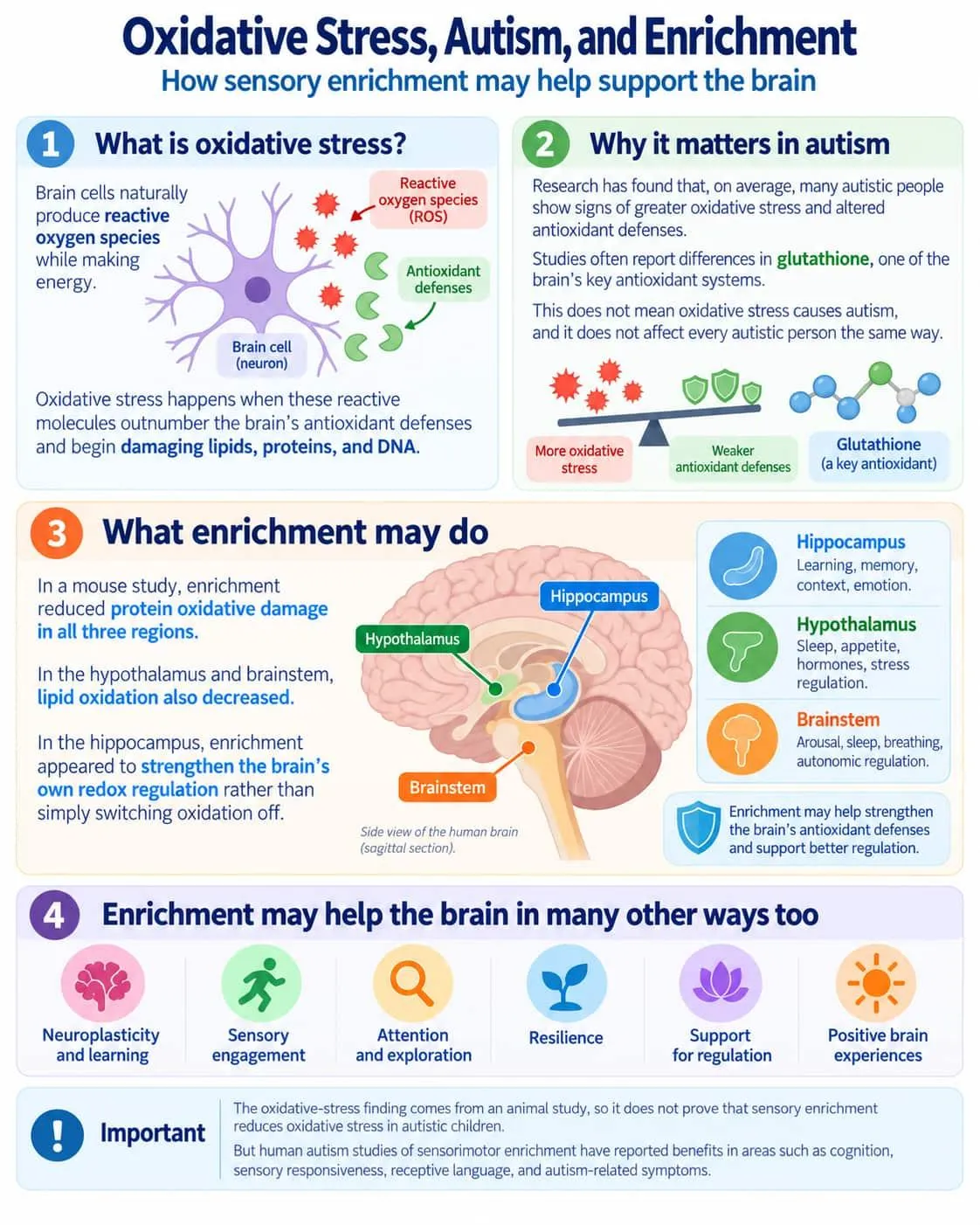
New research suggests enrichment strengthens the brain’s biological defenses against oxidative stress.
We have known for decades that an enriched environment can change the brain. Enrichment can influence learning, memory, connectivity, neuroplasticity and resilience.
A new study gives us another fascinating piece of that picture: enrichment may also change how the brain protects itself from oxidative stress.
What is oxidative stress?
Every cell in your body uses oxygen to produce energy. In the process, it also produces reactive molecules called reactive oxygen species.
That is normal. In fact, small amounts of these molecules are important signals that help cells adapt and change.
Problems arise when the production of these reactive molecules exceeds the brain's ability to control them. They can then begin damaging proteins, cell membranes and other cellular structures. This is called oxidative stress.
The brain is particularly sensitive to oxidative stress because it consumes enormous amounts of energy and its cell membranes contain fats that are vulnerable to oxidation.
The brain has several systems for keeping itself healthy and maintaining the right chemical environment. Antioxidant defenses help control reactive molecules, while other systems help clear away metabolic waste.
Sleep is particularly important for that second job. During sleep—especially deep, non-REM sleep—the brain's glymphatic system becomes more active, helping move metabolic waste out of brain tissue. Researchers have found evidence that this clearance system may not function as efficiently in a number of neurological conditions. That is one of the many reasons good-quality sleep is so important for maintaining brain health.
Researchers have repeatedly found evidence that, on average, people with autism show greater oxidative stress and diminished antioxidant defenses.
What happened when researchers enriched the animals' environment?
In this new study, adolescent female mice spent three weeks in an enriched environment with a larger living space, social interaction, running wheels, tunnels, ladders and changing objects that provided sensory, cognitive and motor stimulation.
The researchers then examined three important parts of the brain: the hippocampus, hypothalamus and brainstem.
They found less oxidative damage to proteins in all three regions.
They also found evidence that the brains had changed the way they defended themselves against oxidative stress. In the hypothalamus and brainstem, lipid oxidation was reduced as well.
Why do these three brain areas matter?
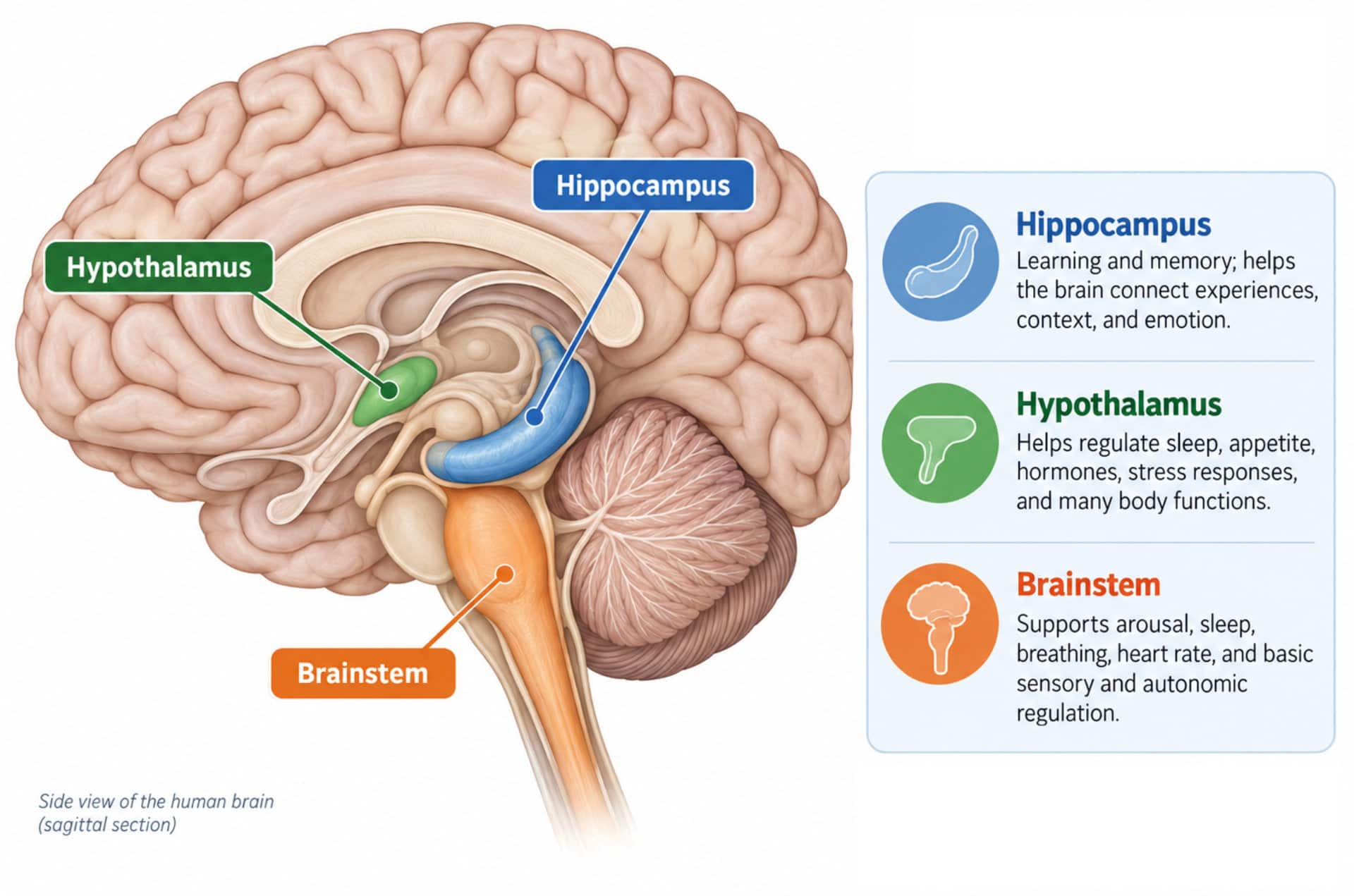
The hippocampus is deeply involved in:
learning,
forming memories,
using previous experience to understand what is happening now,
emotion, and
stress response.
The hypothalamus is one of the brain's major regulatory centers. It helps regulate:
sleep,
appetite,
body temperature,
hormones,
stress responses, and
many aspects of the autonomic nervous system.
The brainstem helps regulate some of our most fundamental functions, including:
arousal,
sleep,
breathing,
heart rate and autonomic regulation,
sensory processing,
proprioception,
motor information traveling through the nervous system.
One more reason to be interested in sensory enrichment
Clinical studies of sensorimotor enrichment in children with autism have already reported improvements in areas including cognition, sensory responsiveness, receptive language and autism-related symptoms.
Now animal research is continuing to reveal some of the many biological systems that respond to enrichment.
Oxidative regulation may be another one.
So if you have been considering sensory enrichment, this is another interesting piece of evidence explaining why providing the brain with rich, varied and meaningful experiences may matter.
And if sensory enrichment is already part of your family's routine, this study gives us one more window into something remarkable:
The experiences we give the brain don't just give it information. They can change how the brain responds, adapts and protects itself.
de Sousa Fernandes MS, Kanashiro A, Ramos TL, Pereira DD, de Souza VL, Lagranha CJ, Tüfekci S, Yagin B, Alkhamees NH and Souto FO (2026) Short-term environmental enrichment modulates brain region-specific redox responses in adolescent female mice. Front. Aging Neurosci. 18:1889960. doi: 10.3389/fnagi.2026.1889960